Review ·
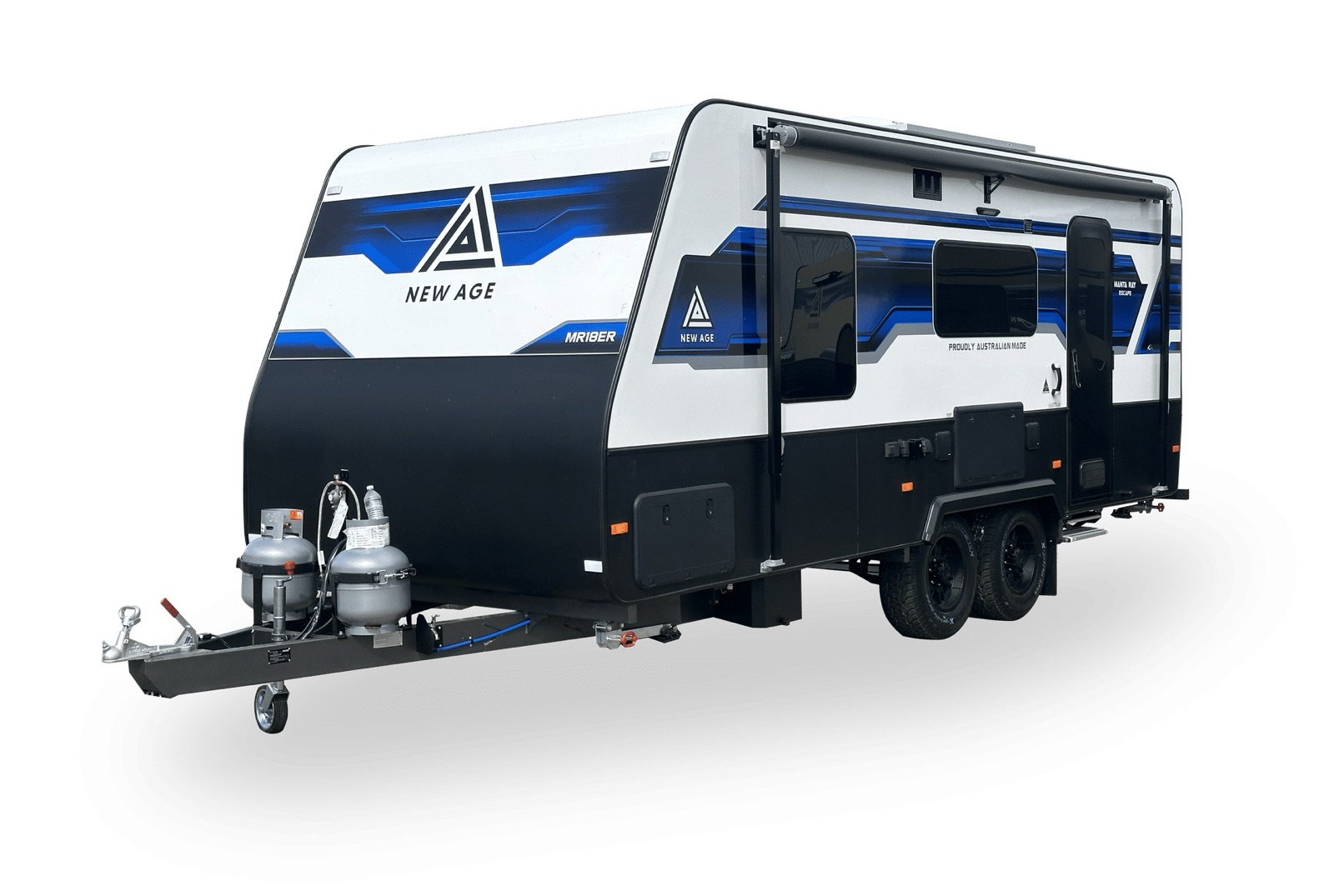
New Age Manta Ray Escape MY26 review: Australia's mass-market composite caravan, sized right
7.5/10New Age moved the entire on-road Manta Ray range to full composite construction in MY25 without raising prices. The 19ft Escape is the volume seller — the closest Australian mainstream gets to European-style build.
Build quality
8/10
Layout
7.5/10
Value
8/10
Verdict
New Age made the right bet moving the on-road range to composite without raising prices. The Manta Ray Escape is the closest Australian mainstream gets to European-style construction at $79,990 — build quality competitors charge $10–15k more for. Not the cheapest, not the most off-grid capable, but the most future-proof in the mid-size on-road segment.
What we like
- ✓ Full composite construction (fibreglass sandwich walls + roof, honeycomb composite floor) — no timber to rot
- ✓ Same $79,990 sticker as the MY24 timber-frame predecessor — meaningful materials upgrade at zero price premium
- ✓ Sub-3-tonne ATM keeps the tow-vehicle pool wide (mid-size 4WDs, dual-cab utes)
- ✓ Five-variant range from 15ft to 20ft to match couples vs storage vs interior preferences
- ✓ Three-year bumper-to-bumper warranty is class-competitive
What we don't
- ✕ Couples-only layout — no family bunk configuration in the on-road Manta Ray
- ✕ Entry-spec Escape misses some inclusions (front toolbox, second battery) versus higher-trim Manta Ray variants
- ✕ Off-grid spec is mid-tier (200 W solar, AGM standard) — serious free-campers need an upgrade
- ✕ Not the cheapest composite caravan on the market — Chinese imports undercut by 15–25%
The Manta Ray is New Age’s volume-seller in the on-road touring segment — and in MY25/26 it’s the case study in how an Australian mass-market manufacturer responds to imports. The bet: rather than chase the cheapest-possible build, move the whole on-road range to full composite construction (the European format) and hold sticker prices flat. Two model years in, the bet looks correct.
What changed in MY25
The Manta Ray was a timber-framed van for most of its model history. Reviewing the 18ft Ensuite for Caravan World in February 2024, John Ford could fairly describe the build as “well-engineered” while flagging that the “Meranti frame needs vigilant maintenance” — moisture management, screw-point sealing, the maintenance cadence that all timber-framed vans require to age well.
By the time Chris Fincham reviewed the MY25 19ft Escape for caravancampingsales in November 2024, the construction story had pivoted entirely. The MY25 Escape uses 25–35mm thick fibreglass sandwich panels with closed-cell XPS foam cores for walls and roof, plus a honeycomb composite floor — what Fincham described as “mirroring European-style RV manufacturing approaches” used by Jayco and Snowy River.
The materials change is meaningful for three reasons:
- No timber means no moisture-rot vulnerability — the historic Achilles’ heel of Australian aluminium-clad-on-timber-frame caravans
- Better thermal insulation — the foam-core panels run R-values roughly 30–40% above traditional construction
- Weight reduction — composite panels are roughly 20% lighter per square metre than equivalent framed construction
Critically, New Age held the price flat. The MY24 timber-frame 19ft Escape was $79,990. The MY25/26 composite 19ft Escape is $79,990. The buyer gets a materially better product at the same sticker — that’s the unusual move.
Layout and living
The 19ft Escape is a couples van. Front island queen bed, café-style dinette opposite the kitchen, internal ensuite with separate shower and toilet at the rear. The 7.99 m overall length is what most Australian caravan parks treat as the “standard” upper bound — anything longer attracts oversize-site fees.
Fincham’s review flags that the entry-spec Escape “misses out on a few items like a front toolbox and second battery” versus higher Manta Ray trims — fair criticism, though most buyers spec those as dealer add-ons or aftermarket installs without changing the headline value proposition. Standard inclusions on the Escape are the usual mass-market checklist: reverse-cycle air conditioning, three-burner cooktop, microwave, large 3-way fridge, separate ensuite, electric awning, reversing camera, 200 W solar with AGM battery (lithium is an upgrade option).
For the off-road sibling, Rachael Doherty’s What’s Up Downunder review of the 19ft Expedition (October 2025) tested the same family on the off-road variant with XT Freestyle Cruisemaster suspension, finding it “just floats through” corrugations and “handled the abuse like nothing else.” For the on-road Escape reviewed here, the running gear is conventional leaf-spring tandem — fine for sealed roads and well-formed gravel, not intended for the Plenty or the Canning.
On the road
Towing the 18ft Ensuite variant behind a Walkinshaw-tuned Volkswagen Amarok V6, Ford reported the pairing worked well — though he noted the 2,790 kg ATM also suits “mid-range tow vehicles like the Isuzu MU-X.” The 19ft Escape sits in the same envelope (Tare 2,271 kg, ATM 3,000 kg, ball weight 141 kg per New Age’s published figures), comfortably towable by a Prado 250, Triton GLS, Ranger Wildtrak V6 or any of the 3.0L diesel utes that dominate the Australian tow-vehicle market.
The 729 kg payload headroom (ATM minus Tare) is reasonable but not generous for big-lap setups — for a full-time-touring couple loading water, gas, food, bedding, recovery gear and aftermarket extras, expect 500–600 kg of that headroom to disappear. Watch the ball weight especially: at 141 kg the Escape is light-hitch by AU standards, which is good news for the tow-vehicle’s rear axle but worth re-checking after loading.
Where it sits in the market
The Manta Ray Escape is the closest Australian mainstream gets to European-style construction. Jayco’s Discovery range matches it broadly (Discovery hardtops use similar composite construction in the MY26 lineup) but lacks New Age’s mid-range range breadth. The Snowy River brand offers similar materials at higher price points. Chinese-built composite imports undercut the Manta Ray by 15–25% but lack the established AU dealer network and warranty track record.
Fincham’s expert rating was 82/100 — squarely positioning the Manta Ray Escape as a buy-with-confidence choice in the mid-tier on-road segment without claiming it’s exceptional.
That feels about right. The Manta Ray Escape isn’t the cheapest van you can buy ($79,990 isn’t entry-level). It isn’t the most off-grid capable (200 W solar and AGM standard is modest). It isn’t the most family-friendly (couples only, no bunk option in the on-road range). What it IS: the most future-proof construction in the segment at a price that doesn’t punish you for taking it. For couples doing the Big Lap on sealed roads with reliable dealer support, it’s the rational mainstream choice in 2026.
Specifications
Manufacturer figures for the New Age Caravans Manta Ray.
At a glance
- Body style
- Caravan
- Segment
- Mid-size
- Berths
- 2 berths
- Layout
- Front queen bed, ensuite to rear or side (variant-dependent), kitchen and dinette
- Bed configuration
- Island bed
- Ensuite
- Internal
- Off-road rating
- On-road
Dimensions
- Length (overall)
- 7,985 mm
- Length (body)
- 6,900 mm
- Width
- 2,400 mm
- Height
- 2,900 mm
Weights
- Tare
- 2,271 kg
- ATM (max legal)
- 3,000 kg
- Ball weight
- 141 kg
- Payload
- 729 kg
Construction
- Suspension
- Leaf
- Frame
- Composite
- Cladding
- Composite panel
Self-sufficiency
- House battery
- 100 Ah (AGM)
- Solar
- 200 W
- Air conditioner
- Yes
- Toilet
- Cassette
- Hot water
- Yes
Pricing & origin
- Price from
- $74,490
- Built in
- Australia
- RVMAP accredited
- Yes
- Warranty
- 3 years
- Sale status
- on sale
Sources
- 1. Caravan review: New Age Caravans Manta Ray 18ft Ensuite — Caravan World (John Ford, 26 Feb 2024)
- 2. New Age Manta Ray Escape 2025 Review — caravancampingsales.com.au (Chris Fincham, 11 Nov 2024)
- 3. New Age Manta Ray 19ft Expedition Review – Building on Strong Foundations — What's Up Downunder (Rachael Doherty, 14 Oct 2025)